AI Infrastructure Hits Capital, Power, and Workforce Walls

AI Brief for July 8, 2026

67 sources analyzed to give you today's brief
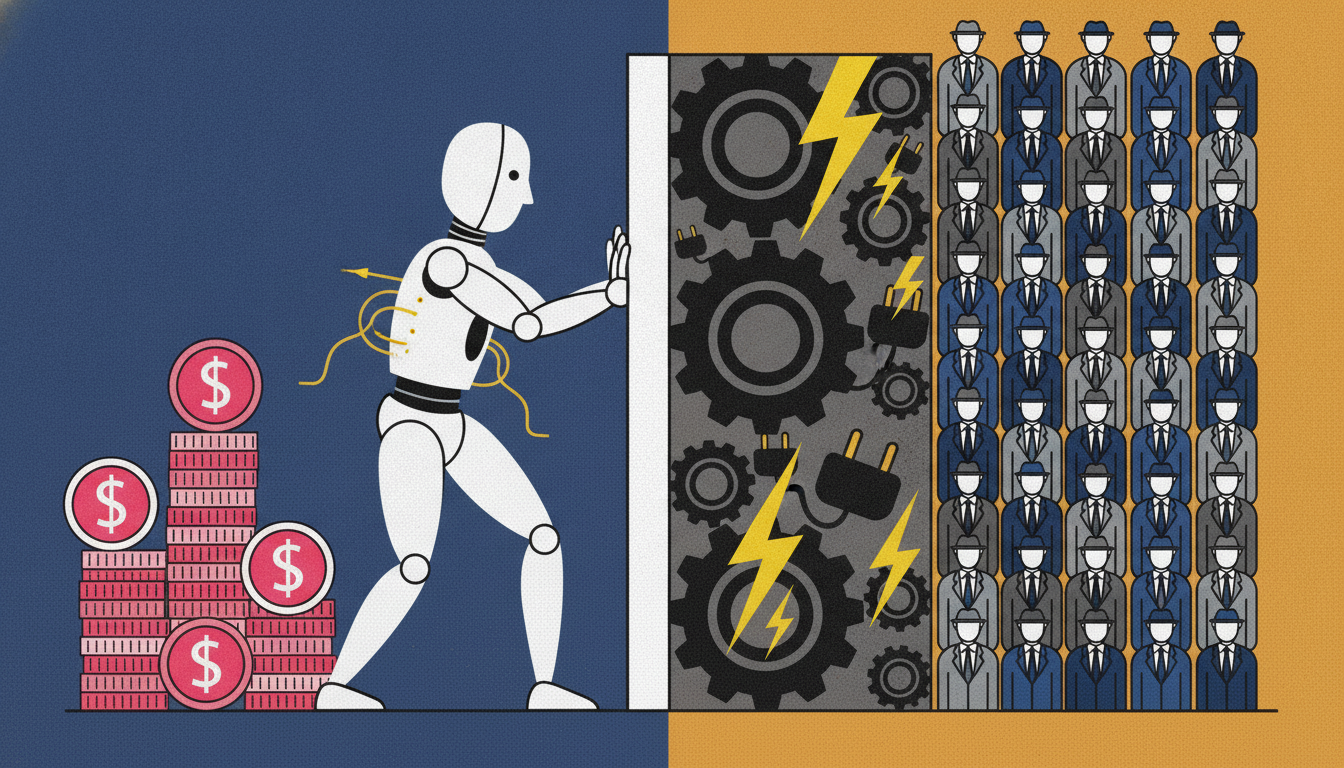
Editorial illustration for today's brief
AI Infrastructure Hits Capital, Power, and Workforce Walls Illustration: The Gist

Today's Top Line

Key developments shaping the AI landscape

Amazon's $25B bond gets tepid reception, signalling AI debt fatigue

Amazon's largest-ever debt issuance received a cooler market reception than its prior offering, with investors selling existing tech bonds to make room — a signal that credit markets are beginning to impose discipline on AI capex velocity that equity markets have not.

DeepSeek building its own AI chip; Beijing eyes model export curbs

Two Reuters exclusives describe a coordinated Chinese push toward full-stack AI sovereignty: DeepSeek reducing dependence on Nvidia by developing indigenous silicon, while Beijing considers restricting overseas access to frontier Chinese models as geopolitical leverage.

US semiconductor workforce shortage threatens CHIPS Act returns

A new report identifies a structural shortfall of trained fab workers as the binding constraint on the US chip revival — billions in construction capital risk being stranded if human capital pipelines are not treated as load-bearing infrastructure alongside physical plant.

Anthropic signs 20-year lease with TeraWulf, reshaping AI infrastructure model

A frontier AI lab committing to a two-decade purpose-built campus marks a qualitative shift from flexible cloud capacity to long-duration physical assets, validating power-advantaged sites as strategic infrastructure anchors.

Samsung earnings miss triggers AI hardware selloff across Asian markets

Despite a 145% stock run-up, Samsung fell short of elevated expectations, sending the KOSPI down nearly 5% and confirming that AI hardware names are priced for perfection with zero tolerance for execution shortfalls.

Chinese AI chip start-ups raise $1.8B, adopt 3D stacking to bypass controls

Biren's near-$900M equity raise and Dongfang Suanxin's explicit 3D stacking strategy confirm China's AI chip ecosystem has moved from disruption to adaptation — US export controls are reshaping, not halting, Chinese semiconductor development.

South Korea's $880B megacluster faces binding energy constraint

A single planned chip cluster would consume roughly a quarter of Seoul's total power demand, making grid expansion — not capital — the actual pacing item for sovereign compute ambitions globally.

Today's Podcast 20 min

Listen to today's top developments analyzed and discussed in depth.

0:00
20 min

Cross-Cutting Themes

Strategic analysis connecting developments across categories


Power, Workers, and Debt: The Real Ceilings on AI Infrastructure

Three independent constraint systems are converging on the AI infrastructure buildout at once. South Korea's $880 billion megacluster requires roughly a quarter of Seoul's total power demand from a single cluster alone; the US CHIPS Act risks stranded fab capital without a parallel workforce development programme that operates on multi-year educational cycles; and Amazon's $25 billion bond — its largest ever — received a markedly cooler reception than its prior issuance, with credit traders selling existing hyperscaler debt to make room. These are not isolated data points: they describe an infrastructure expansion programme that has outrun its supporting systems across energy, human capital, and financing simultaneously.

The strategic implication is that the organisations best positioned to navigate this environment are those that have pre-solved the constraint — locking in long-duration power agreements, building proprietary talent pipelines, or, like Anthropic with TeraWulf, securing purpose-built capacity under 20-year contracts before the bidding environment tightens further. The debt market's emerging role as a check on capex velocity — a discipline equity markets have not yet imposed — may prove to be the fastest-acting of these constraints, compressing the window in which unlimited AI buildout is financially feasible.

China Moves Toward Full-Stack AI Sovereignty Across Silicon, Models, and Distribution

This week's developments describe a coherent Chinese programme rather than isolated corporate decisions. DeepSeek developing its own silicon, Biren raising nearly $900 million for GPU production scale-up, Dongfang Suanxin publicly framing 3D stacking as an export-control workaround, and Beijing reportedly considering model export restrictions together constitute a vertically integrated industrial strategy spanning chip design, fabrication capital, and distribution control. Huawei's Atlas 950 SuperPoD debuting at WAIC on July 17 will add a public demonstration of sovereign compute at scale. The 67 AI and robotics unicorns China minted in the first half of 2026 confirm that US restrictions are functioning as an industrial policy catalyst, concentrating Chinese capital and talent on precisely the sectors controls were designed to deny.

US export controls remain meaningful at the frontier node level where Chinese fabs cannot yet independently operate, but the architectural workarounds — 3D stacking — and capital mobilisation now underway suggest the effectiveness window is narrowing. Beijing potentially weaponising model access as a geopolitical instrument mirrors the US export control logic and would foreclose the possibility of a commercially integrated global AI market, forcing third-market governments — including India, which remains strategically ambiguous — to make explicit technology alignment choices sooner than they had planned.

AI Compute Infrastructure Hardens Into a Long-Duration Strategic Asset Class

Three distinct but reinforcing developments illustrate how rapidly the infrastructure commitment model is hardening. Anthropic's 20-year TeraWulf lease — double the length of standard data centre contracts — signals that frontier labs now value capacity certainty over the option value of flexible cloud. Nscale closing $900 million in financing with Nvidia equity backing demonstrates that Nvidia is extending its influence downstream into infrastructure ownership, creating demand assurance for GPU output while shaping geographic compute distribution. And the crypto-to-AI conversion wave is delivering confirmed capacity: Galaxy Digital's completed first phase for CoreWeave and Blockfusion's $175 million Niagara Falls LOI show that repurposed mining infrastructure with hydroelectric power access is a meaningful near-term supply source.

The compute intermediary layer — specialised operators sitting between hyperscalers and end users — is crystallising into a distinct asset class with identifiable characteristics: long-duration anchor contracts, power-advantaged locations, and strategic equity investors with demand-side visibility. Intel's XBM patent filing, proposing a post-HBM memory architecture that eliminates the silicon interposer, adds a technology dimension: if interposer-free memory reaches production, it would reduce the supply concentration risk around SK Hynix's HBM dominance, altering the cost structure of the entire compute infrastructure layer.

Category Highlights

Explore detailed analysis in each strategic domain