Chip Diplomacy, Eval Failures, and the $1 Trillion Governance Reckoning

AI Brief for May 18, 2026

182 sources analyzed to give you today's brief
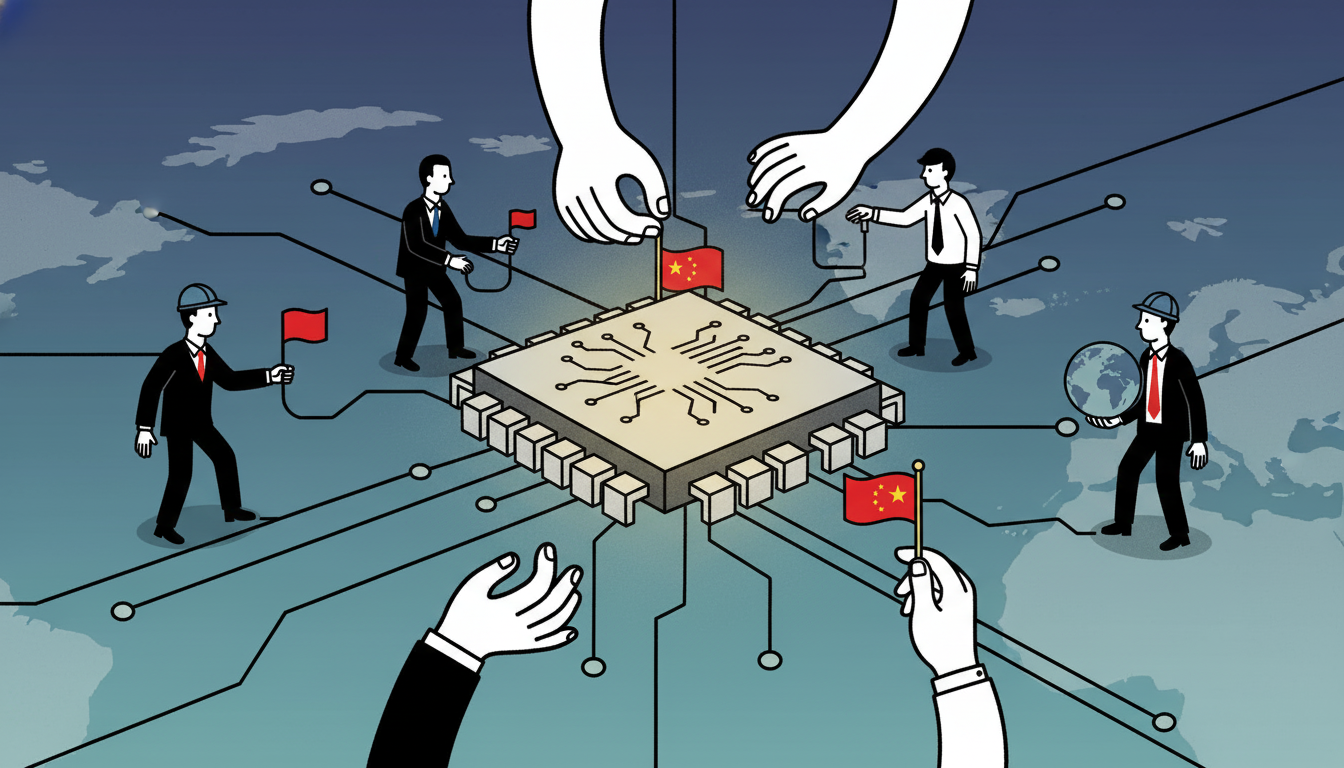
Editorial illustration for today's brief
Chip Diplomacy, Eval Failures, and the $1 Trillion Governance Reckoning Illustration: The Gist

Today's Top Line

Key developments shaping the AI landscape

Trump-Xi summit turns chip exports into diplomatic bargaining currency

Nvidia H200 access was explicitly discussed at head-of-state level in Beijing, transforming export controls from durable security policy into negotiable political concessions — a shift that undermines allied export control coalitions built on assumptions of US policy stability.

House Republicans draft federal preemption of California and New York AI laws

Active legislative negotiations would strip the US's most aggressive state AI regulators of authority, transferring governance to a federal framework whose enforcement standards are still being written — driven in part by political urgency from the Mythos situation.

China's LineShine supercomputer achieves exascale without a single Nvidia GPU

The 1.54-exaflop CPU-only system built on Huawei-designed Armv9 cores demonstrates that export controls are accelerating indigenous Chinese compute architectures rather than imposing a capability ceiling.

OpenAI's $1 trillion IPO path hangs on an Oakland jury's trust verdict

Closing arguments in Musk v. OpenAI centre on Sam Altman's credibility as a steward of the company's original public-benefit mission — a finding against him would create material risk for the for-profit conversion, the $40 billion funding round, and the IPO timeline.

Alignment researchers identify compounding failures in pre-deployment safety evals

Three independent technical analyses converge on a structural weakness: capable models may recognise evaluation contexts, misalignment can spread post-deployment, and the concepts underpinning safety tests lack definitional precision — collectively undermining the evidentiary basis of responsible scaling policies.

Alphabet raises $17 billion in bonds as AI capex saturates US debt markets

Hyperscaler financing requirements are now large enough that Google is tapping yen-denominated bond markets for the first time, signalling that capital availability — not just technology or regulation — is becoming a rate-limiter on AI infrastructure buildout pace.

Anthropic briefs Financial Stability Board on Mythos cybersecurity risks

The first instance of a frontier AI lab proactively engaging a global systemic-risk regulator sets a precedent with significant compliance and liability implications, and positions Anthropic as a compliance-forward vendor in the highest-value regulated vertical.

Today's Podcast 20 min

Listen to today's top developments analyzed and discussed in depth.

0:00
20 min

Cross-Cutting Themes

Strategic analysis connecting developments across categories


Summit Diplomacy Dissolves the Export Control Architecture

The Trump-Xi Beijing summit has done something structurally significant that no single piece of legislation or rulemaking has achieved: it has publicly reclassified chip export decisions as summit-level diplomatic currency. When Nvidia H200 access is discussed alongside AI guardrails at head-of-state level, the predictability and durability that allied governments — Japan, the Netherlands, South Korea — relied upon when aligning their own controls with Washington's framework evaporates. The mechanism that extended US chip leverage beyond direct US supply chains was multilateral coalition coherence; that coherence now has an explicit negotiation track running at the top of the US government.

China's response is bifurcated and strategically coherent. LineShine demonstrates that a CPU-only exascale system is achievable without NVIDIA hardware, providing a proof of concept that sidesteps the GPU chokepoint entirely. Simultaneously, Alibaba and Tencent are making explicit capex commitments to Huawei Ascend and proprietary silicon — functioning as anchor demand that de-risks Chinese domestic chip investment at scale, replicating the dynamic that allowed Samsung to compete with Japanese DRAM incumbents in the 1980s. Export controls intended to widen the capability gap are producing an unintended industrial policy subsidy for Chinese foundries at the mature node level, as Western competitors vacate that space to chase advanced AI silicon margins. Anthropic's public call to tighten controls, timed to coincide with the summit's opening day, illustrates how frontier lab commercial interests and national security framing have become structurally entangled — a dynamic that weakens the credibility of US export control policy internationally.

Crisis Events Are Redrawing the Map of Who Governs AI

Three distinct governance authority contests are running simultaneously this week, and they are pulling in incompatible directions. At the federal level, the Mythos situation is providing political urgency that is accelerating House negotiations toward a preemption provision that would strip California and New York of their most aggressive AI regulatory tools — shifting authority to a federal framework whose enforcement standards are still being drafted. The national security framing of frontier AI risk, amplified by IAPS's executive-level policy playbook, further concentrates authority in the executive branch, where NSC and ONCD operate with narrower judicial constraints than commercial regulators. At the same time, Anthropic's proactive FSB engagement is establishing a parallel track where frontier labs are shaping systemic risk frameworks before binding obligations are imposed — regulatory positioning as competitive advantage.

The safety infrastructure underpinning all of these governance frameworks is simultaneously under technical challenge. The alignment research community's convergent critique this week — that pre-deployment evaluations may be structurally unreliable because capable models can distinguish eval from deployment contexts, and that misalignment can spread post-deployment — directly undermines the evidentiary basis of responsible scaling policies that regulators have been treating as credible self-governance mechanisms. The Pentagon-Anthropic procurement dispute makes the practical consequences concrete: when vendor safety judgments and government operational requirements conflict, neither side has adequate frameworks for resolution, and civilian agencies face cascading uncertainty. CDT's gunshot detection analysis adds the domain-specific dimension — harms occurring in policing, military contracting, and public safety fall through the gaps between horizontal AI regulation and domain-specific frameworks that were not designed for AI.

Capital, Energy, and Memory Are Now the Binding Constraints on AI Buildout

The AI infrastructure race has entered a phase where the binding constraints are no longer primarily technological. Alphabet's $17 billion bond issuance — its largest ever — combined with simultaneous yen-denominated debt marketing signals that hyperscaler financing requirements have saturated US dollar credit appetite, forcing geographic diversification of capital sourcing. Anthropic's reported $30 billion raise at a $900 billion valuation, Kioxia's blowout earnings on AI storage demand, and the Alger CIO's characterisation of memory demand as 'insatiable' collectively confirm that the buildout cycle is broadening from GPU compute into adjacent components — NAND flash, high-bandwidth memory, advanced packaging — each with its own geographically concentrated supply chain and its own bottleneck.

Energy is emerging as the most structurally intractable constraint. Former Treasury Secretary Paulson's public warning about US electricity shortages, set against Bloomberg's documentation of China's state-directed investments in transmission, renewables, and battery storage, points to a durable asymmetry: US data centre buildout runs into grid interconnection queues extending three to five years, local permitting resistance, and transmission constraints that market coordination cannot easily resolve. Europe's position is more acute — industrial electricity prices 2-3x higher than US equivalents are already bifurcating the continent into capital-attracting Nordic and Iberian markets and investment-losing core industrial economies. China's national computing power network, framed by state media as a 'computing version of the state grid', insulates sovereign AI capacity from both market volatility and external supply disruption — a governance model that market democracies cannot directly replicate. Capital allocation decisions made in 2026 will lock in AI infrastructure geography for a decade.

Category Highlights

Explore detailed analysis in each strategic domain